
From Research to Practice: Using Search and Discovery to Serve Residents
How GovFeeds transforms the way residents find government information.
1/21/20263 min read
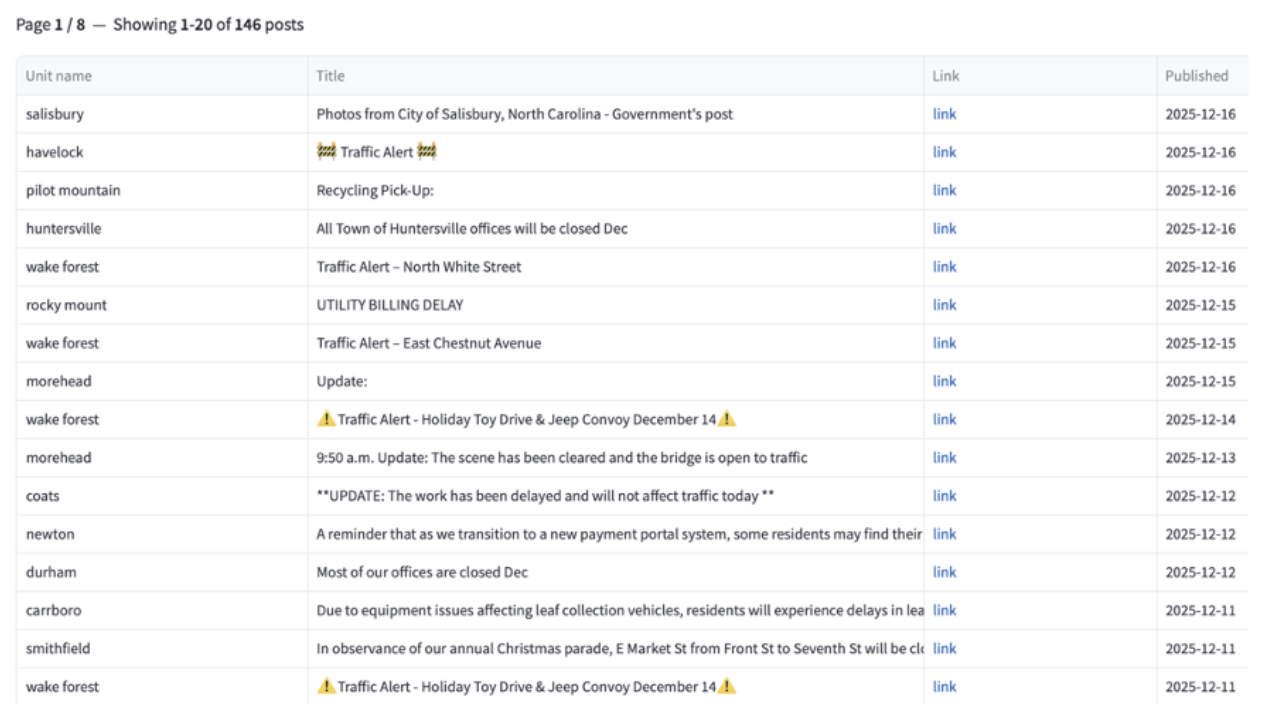
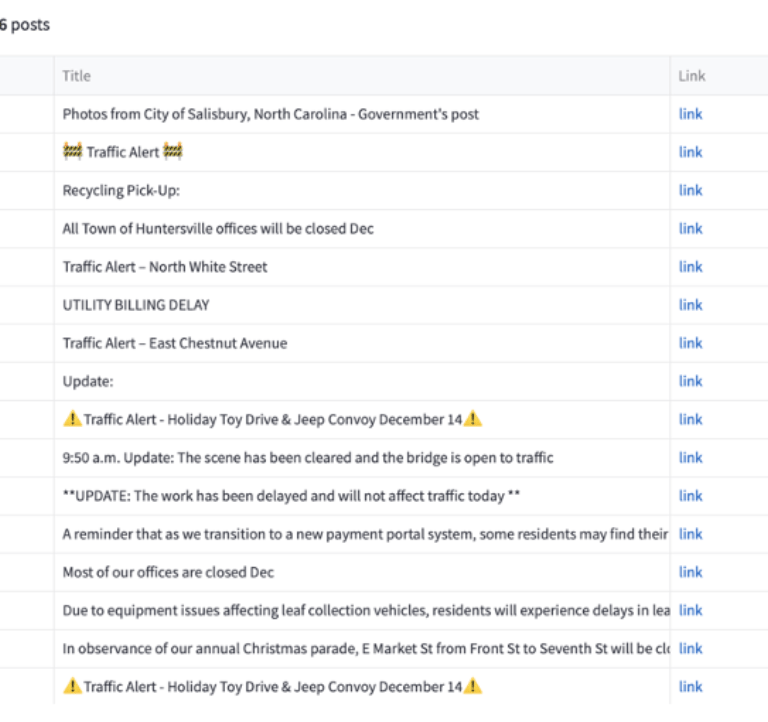
Something interesting has happened over the past few years. When a meeting gets postponed or a service gets delayed, many residents don't immediately check the official city website or sign up for text alerts. Instead, they do what feels natural in 2025—they open Facebook and type in a few keywords: "delay," "postpone," "closed," "tonight."
Think about that for a moment. Social media platforms have quietly evolved into informal search engines for local government information. And if you're managing communications for a city or county, this shift changes everything.
Social platforms as public information systems
For years, researchers who study government communication have emphasized the importance of getting timely, accurate information out to as many people as possible—especially during emergencies and service disruptions. That makes sense. But what scholars have studied less is what happens after you hit "post." How do residents actually encounter these messages in the wild?
Unlike traditional press releases or updates buried on a government website, social media posts exist in algorithmic environments. They're shaped by feeds, shares, and—critically—search functions. Discovery is fragmented. It's nonlinear. And it's often delayed. A resident might search for information hours or even days after you published it.
This reality reframes what a social media post actually is. It's not just a real-time announcement. It's a searchable public record.
What GovFeeds reveals about resident search behavior
We've spent considerable time analyzing how residents interact with government social media through GovFeeds, our platform designed specifically for local government analytics. One pattern keeps emerging: When we examine Facebook posts from North Carolina city pages that surface in searches for keywords like "postpone" and "delay," we find posts about meeting cancellations, weather-related disruptions, and service interruptions.
Two findings stand out.
First, residents are actively using social platforms to retrieve information—not just consume it passively as it scrolls by. This aligns with broader research showing that citizens increasingly rely on platforms for political and civic information retrieval. They're treating Facebook like Google, but for hyperlocal government updates.
Second, the posts that surface consistently in these searches share something in common: explicit, concrete language. Posts that clearly state what changed, when it changed, and why are easier to locate and interpret than posts relying on vague phrasing or assuming the reader already has context.
This might seem obvious, but it's not how most government social media works in practice.
Discoverability is a design choice
Here's the thing: Discoverability isn't about gaming algorithms or learning SEO tricks. It's about designing communication for how people actually use it in real life.
Residents searching for information are often doing so under less-than-ideal circumstances: limited time, divided attention, stress, or uncertainty. Posts that prioritize clarity over cleverness serve them better. Posts that embed critical details only in images, use abbreviations without explanation, or depend on links to external sites are harder to find and understand later.
From a research perspective, this connects to work on service-oriented government communication, which emphasizes accessibility, neutrality, and clarity over persuasion. When the government communicates a service change or disruption, the goal isn't to be memorable or catchy—it's to be findable and useful.
GovFeeds supports this work in a few concrete ways. It allows communication teams to:
Search across multiple jurisdictions for similar announcements
Compare how different cities phrase comparable messages
Identify recurring language patterns that improve discoverability
Rather than simply copying "top-performing" posts, teams can learn why certain messages surface reliably. That's a more sustainable approach than chasing engagement metrics.
Designing posts for future readers
Here's an under appreciated aspect of government social media: Posts often serve residents who weren't even following your page when you published it.
A resident searching for "delay" today might encounter a post you wrote several days ago. This makes clarity and specificity even more important. If someone stumbles on your post through search, they won't have the context from previous posts or announcements. They need to understand the message on its own.
GovFeeds makes this visible by treating posts as part of a searchable corpus rather than ephemeral feed items. You can see what language makes posts discoverable days or weeks after publication.
Discovery as an equity issue
Finally, let's talk about why this matters beyond metrics and efficiency. Discoverability isn't just a technical concern—it's an equity issue.
Residents shouldn't need insider knowledge, perfect timing, or algorithmic literacy to find information that affects their daily lives. When official information is hard to locate, misinformation fills the gap..
By treating discoverability as a core service function—and by using tools like GovFeeds to understand how residents actually search—local governments can better fulfill their public mission.