
Introducing The Briefing: A Weekly Intelligence Report on Government Communications
3/31/20263 min read
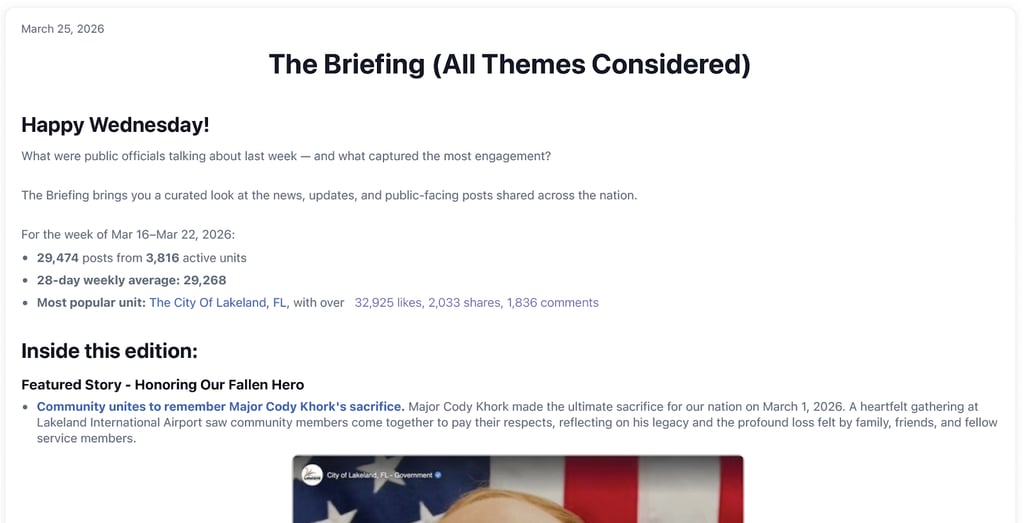
There has never been more public communication coming from local governments than there is today. On any given week, thousands of agencies across the country are publishing updates—on public safety, infrastructure, community events, policy decisions, emergencies, and everything in between. Taken together, this activity represents a kind of distributed, real-time narrative of how governments engage with the public.
To make sense of that landscape, we’re introducing The Briefing (All Themes Considered)—a new weekly newsletter designed to provide a clear, structured view of how governments are communicating across the country.
The idea behind The Briefing is straightforward: if the volume of communication has increased dramatically, then the ability to interpret it needs to evolve as well. Because while the volume has increased, visibility has not.
Most communications teams still operate within a relatively narrow field of view. They see their own channels, a handful of peer jurisdictions, and whatever happens to cross their feeds. The broader landscape—what hundreds or thousands of other governments are saying, how the public is responding, what patterns are emerging—remains largely out of reach.
Communications teams today are not only responsible for disseminating information. They are expected to interpret public sentiment, anticipate reactions, respond quickly under pressure, and maintain credibility in environments where trust can shift rapidly. In that kind of setting, decisions are rarely made in isolation. They are made—implicitly or explicitly—against a backdrop of what others are doing, what the public expects, and what has worked elsewhere. The challenge is that this backdrop is difficult to see.
Over time, we’ve found that many of the most important questions in government communications are comparative in nature. Not just What should we say?, but How are others saying it? Not just Did this perform well?, but Is this typical? Not just What is happening here?, but What is happening everywhere else?
Answering those questions requires more than anecdotal awareness. It requires access to a wider field of data, and a way to interpret it without being overwhelmed by it.
That is the problem GovFeeds was built to address. GovFeeds aggregates and analyzes public-facing communication from thousands of local governments, making it possible to observe patterns at a scale that would otherwise be impractical. But as we’ve worked with teams using the platform, one thing has become increasingly clear: access to data alone is not enough.
What people need is synthesis. The Briefing is our attempt to provide that synthesis in a consistent, accessible form.
Each week, it starts with the full scope of activity—tens of thousands of posts from thousands of agencies. For example, in a recent week, there were over 29,000 posts published by more than 3,800 active units. That scale is important, because it reflects the breadth of the ecosystem. But it is not, by itself, actionable.
The work lies in distillation.
From that volume, we identify signals: which topics are generating engagement, which jurisdictions are seeing outsized responses, which types of messages are resonating within specific domains such as public safety, infrastructure, or community engagement. We surface not only aggregate trends, but also concrete examples—individual posts that illustrate how those trends are playing out in practice.
This combination of scale and specificity is intentional.
High-level metrics provide orientation, but examples provide understanding. Seeing that a particular type of message is performing well is useful; seeing how it was actually written, framed, and received is what allows that insight to be applied.
Just as importantly, the structure of The Briefing is designed to reduce cognitive load rather than add to it.
Communications professionals are already inundated with information. The goal is not to create another stream to keep up with, but to offer a periodic point of clarity—a way to quickly recalibrate one’s sense of the landscape. What happened this week? What stood out? What might be worth paying attention to?
The Briefing provides a shared reference point—a way of understanding not just isolated events, but the broader patterns within which those events occur. For teams making decisions in real time, that kind of context can be quietly transformative. It can validate an approach, challenge an assumption, or surface an alternative that might not have been considered otherwise.
None of this replaces judgment, experience, or local knowledge. But it does augment them.
And as the pace and visibility of public communication continue to increase, that augmentation becomes more valuable. The difference between acting with context and acting without it is often subtle in the moment, but significant over time.
The Briefing is an attempt to make that context more accessible. It is designed for the people who are already doing the work—those responsible for informing the public, shaping narratives, and maintaining trust in complex and often high-stakes environments.
If that resonates, we invite you to subscribe for free and check it out.