
Why More Posting Isn't Always Better—and What to Measure Instead
More posts don’t automatically mean better results. Using GovFeeds data from North Carolina cities, we show why intentional, goal-driven communication beats volume, and what metrics actually matter.
1/8/20263 min read
Quality, strategy, and learning across jurisdictions
In almost every conversation about social media strategy, one assumption keeps appearing: More posting leads to better results.
It sounds intuitive. Stay active. Stay visible. Stay top-of-mind. But GovFeeds data challenges that assumption in a meaningful way.
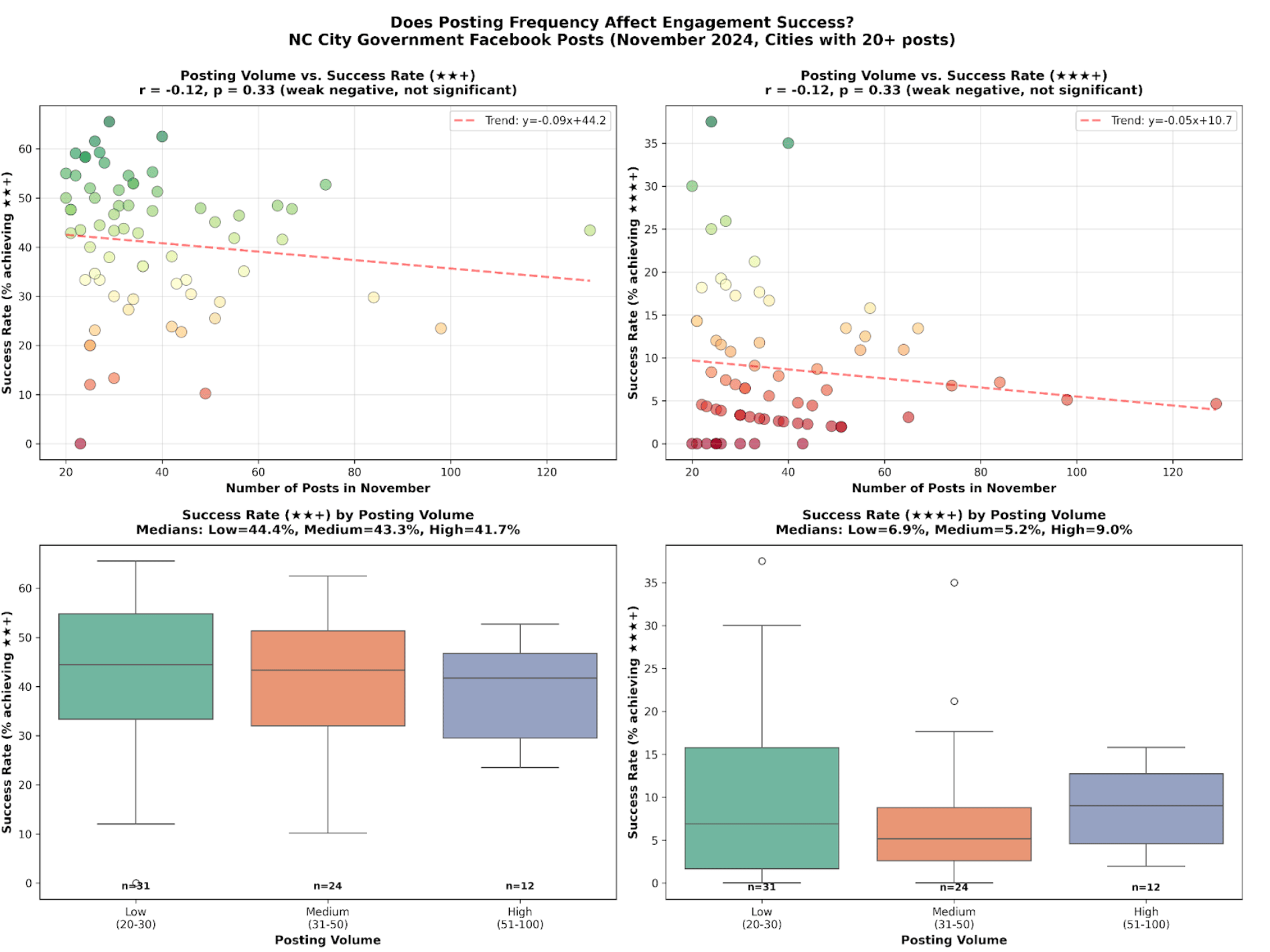
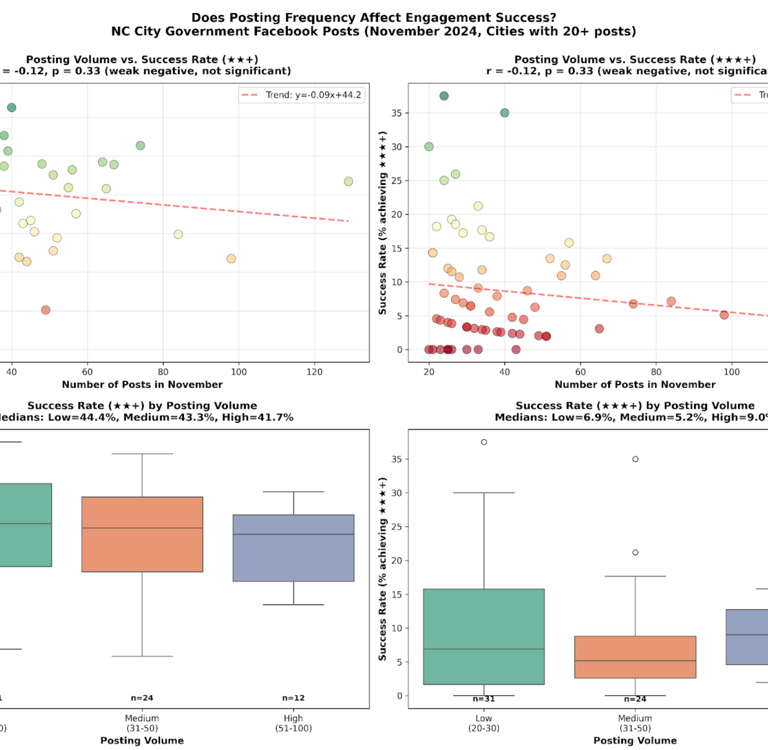
By examining posting frequency and engagement outcomes across all posts on North Carolina city Facebook pages in November 2025, we found no consistent relationship between higher posting volume and stronger engagement. In some cases, higher frequency actually correlated with lower performance.
The myth of frequency as strategy
Posting frequency is appealing as a metric because it's easy to measure and easy to control. You can always post more. But frequency alone tells us very little about communication quality.
Research has repeatedly shown that volume-based strategies can dilute attention and increase message fatigue.. If you post ten times a day, each post competes not just with other content on the platform—it competes with your own other posts.
GovFeeds allows teams to visualize this tradeoff directly by plotting engagement outcomes against posting volume. Sometimes less really is more.
Engagement quality vs. engagement volume
Here's something else our data makes clear: Engagement metrics are not interchangeable.
Likes, shares, and comments do not automatically equal understanding, deliberation, or trust. Treating them as equivalent risks optimizing for the wrong outcomes.
Instead of fixating on raw counts, shift your attention to patterns:
How does engagement vary by content type?
Does posting more frequently improve clarity, or reduce it?
Are certain communication goals better served by fewer, higher-quality posts?
For example, one city in our North Carolina dataset posted 20-30 times in a month and saw moderate engagement. Another posted 50+ times and saw lower average engagement per post. A third posted 15-20 times but invested more in each post—adding visuals, context, and clear calls to action—and achieved higher engagement overall.
The difference wasn't volume. It was intentionality.
Learning across jurisdictions—without rankings
One of GovFeeds' most distinctive features is its support for comparative learning without competition.
Rather than ranking cities against each other (which can create perverse incentives), GovFeeds allows communicators to examine patterns across jurisdictions and ask why something works.
For instance, if three cities all post about a winter storm warning, you can compare:
What language did they use?
How did they structure the information?
Did they include images or links?
What time of day did they post?
How did residents respond?
This approach aligns with research cautioning against one-size-fits-all "best practices" in public communication. What works in a college town of 50,000 might not work the same way in a rural county or a mid-sized industrial city.
Best practice doesn't tell you "Post exactly like City X." It helps you understand the principles underlying effective communication, so you can adapt them to your context.
Measuring what matters
Effective measurement begins with clarity about goals.
Are you trying to:
Inform residents about a service change?
Encourage participation in a community meeting?
Deliver timely emergency information?
Build long-term trust and connection?
Each goal requires different strategies—and different metrics.
Align your metrics with these goals rather than defaulting to engagement volume. You can filter by post type, emotional tone, and time period to see patterns specific to your priorities.
For instance, if your goal is improving resident awareness of council meetings, you might track:
Reach (how many people saw the post)
Click-through rate (if you included a meeting agenda link)
Follow-up questions in comments
You probably wouldn't prioritize likes or shares. Those metrics don't tell you whether residents are more informed or engaged in governance.
Quality over quantity
The lesson from both research and GovFeeds data is straightforward: Posting more is not a strategy.
Intentional, evidence-informed communication is.
That might mean:
Posting less frequently, but with higher production value
Varying post types based on your goals
Using visuals strategically, not automatically
Tracking metrics that align with your mission
It definitely means moving beyond "we need to post every day" as a default approach.
GovFeeds gives you the data to have more productive conversations about strategy. Instead of arguing about whether to post more or less, you can ask: What are we trying to accomplish, and what does the evidence say about how to get there?