
Last week, in Brief
What Local Officials Can Learn From a Week of Government Social Media
4/21/20264 min read
Every week, local governments tell a story about what matters most in their communities.
Sometimes that story is about public safety. Sometimes it is about economic development, parks, infrastructure, schools, or community pride. And sometimes it is about something even more basic: showing residents that their government is present, responsive, and paying attention.
That is exactly why we publish The Briefing at Public Square Analytics.
Our latest issue analyzed 28,663 posts from 3,833 active local government units during the week of April 6–12, 2026. That volume alone says something important: local government communication is not occasional. It is constant. It is one of the clearest windows into what public institutions are doing, what communities are celebrating, and what residents are responding to right now.
For local elected officials, that matters.
Because if you want to understand what is resonating with the public, what peer jurisdictions are prioritizing, and how communities engage with government in real time, you need more than headlines. You need signal.
A week of local government, in one snapshot
This issue of The Briefing captured a remarkable range of public-facing activity.
At the top level, the newsletter highlights a week with nearly 28.7K posts, a 28-day weekly average of 29,260, and 3,833 active units, with activity only slightly below the prior week.
That means thousands of cities, counties, and public agencies are posting constantly about what matters in their jurisdictions. For elected officials, that creates a powerful opportunity: you can see not only what your own government is communicating, but what other communities are emphasizing too.
And the themes in this week’s issue are telling.
The posts that rise to the top are often deeply human
The featured story in this edition focuses on Jacksonville’s groundbreaking for the Tunnel to Towers Foundation Veterans Village, a project that will provide 145 rooms and 18 comfort homes for veterans in need. It is exactly the kind of story that communities rally around: practical, mission-driven, and rooted in public service.
The newsletter also spotlights Denton’s Shiloh Field, described as the largest community garden in the United States, spanning more than 14 acres and helping provide fresh produce to people in need.
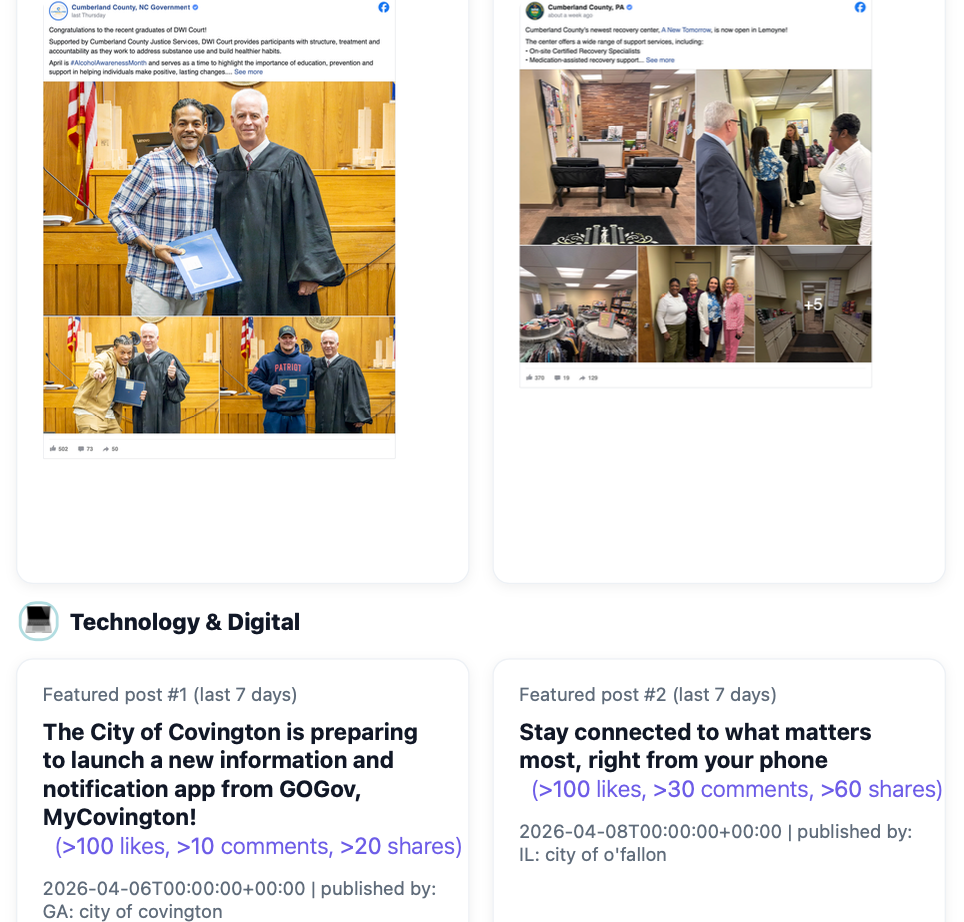
Another highlighted post celebrates graduates of Cumberland County’s DWI Court program, emphasizing recovery, accountability, and education during Alcohol Awareness Month.
These are not random viral moments. They reveal something bigger: some of the most compelling government communication is about care, dignity, and visible community impact.
For local officials, that is a useful reminder. Residents do not just engage with alerts and announcements. They also respond to evidence that local institutions are solving problems, honoring people, and strengthening community life.
Public safety information still drives major engagement
At the same time, the newsletter makes clear that urgency matters too.
The most engaging unit of the week was County of Maui, Hawaii, which led on likes, shares, and overall engagement. Maui’s featured public safety posts focused on East Maui flooding and severe weather conditions as a Kona low approached the state. One flooding-related post generated more than 4,000 likes, 300 comments, and 700 shares.
This is one of the clearest lessons in the newsletter: when public safety issues emerge, residents turn to local government channels immediately. Fast, direct, public-facing communication is not a side function. It is core infrastructure.
For elected officials, that means peer examples matter. How are other jurisdictions framing emergency information? What kinds of posts get amplified? What does useful, trusted communication look like in a fast-moving situation?
Those are the kinds of questions this newsletter helps answer.
Community engagement is not “soft” — it is strategic
One of the most interesting patterns in the issue is how much engagement comes from posts that are not crisis-related at all.
The newsletter highlights strong-performing content about:
local traditions in Myrtle Beach and Columbia,
playground openings and parks programming,
beach renourishment and infrastructure improvements,
business and local market activity,
school and education posts,
new digital notification tools from local governments.
The takeaway is simple: public engagement is shaped by the full range of civic life. Residents respond to safety updates, yes — but also to progress, pride, recognition, amenities, and useful new services.
For elected officials, this broader view matters. It is easy to think of government communication as mainly administrative. But residents experience it differently. They see a running picture of whether their community is improving, whether leaders are paying attention, and whether public institutions feel accessible.
Benchmarking against peers is more valuable than ever
Another strong reason to follow The Briefing is that it helps officials see what peer jurisdictions are doing well.
This issue identifies:
the most productive unit as Gwinnett County, Georgia, with 87 posts during the week,
the most engaging unit as County of Maui,
the most discussed unit as Calvert County, Maryland, with 1,044 comments.
That kind of comparative visibility is hard to build on your own. Most local officials do not have time to manually track thousands of posts across thousands of governments. But seeing those patterns in one place can spark better questions:
What kinds of updates create trust?
Which themes get people to share?
How are similar jurisdictions talking about infrastructure, economic development, or emergencies?
What styles of communication seem to build the most engagement?
That is exactly the kind of intelligence local leaders can use.
Why we publish this newsletter
At Public Square Analytics, we believe local government communication contains an enormous amount of insight — if you know how to read it.
The point of this newsletter is not to overwhelm readers with content. It is to surface patterns, examples, and signals that help public officials understand what is happening across local government right now.
Each issue gives you a quick, practical read on what communities are talking about, what public agencies are posting, and what kinds of messages are actually landing with residents. In this issue alone, you can see how one week of local government communication spans veterans housing, food access, addiction recovery, flood response, parks, infrastructure, education, technology, and community recognition.
That breadth is exactly why the newsletter is useful. It gives elected officials a wider field of vision.
Subscribe if you want better signal, not more noise
If you are a local elected official, your inbox is already crowded.
What you probably do not have enough of is a fast way to understand how local government communication is evolving across the country — what is getting attention, what is building trust, and what other jurisdictions are putting in front of the public.
That is what The Briefing is for.
It is a practical, readable way to stay in touch with the issues, messages, and moments shaping local government right now.
If you want a clearer picture of what local governments are communicating — and what residents are responding to — subscribe to the GovFeeds newsletter from Public Square Analytics.