
Part 3 of 8: Broadcasting, Responding, and Curating: Why Communication Modes Matter
2/13/20263 min read
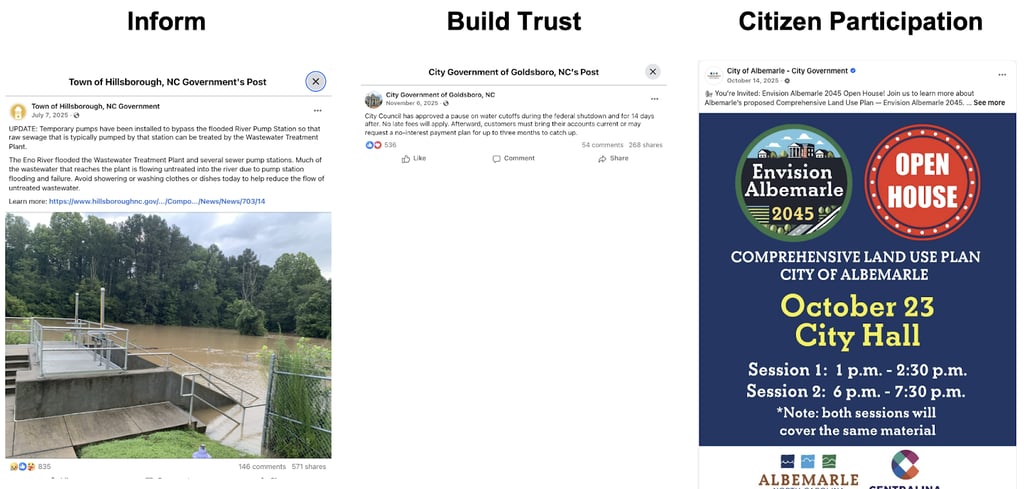

Discussions of government social media often focus on what to say or where to say it. Less attention is paid to a more foundational question: how communication is structured. Research in public administration and communication studies makes clear that social media interaction is not monolithic. Instead, it operates through distinct communication modes, each associated with different goals, risks, and institutional demands.
Understanding these modes—and aligning them with purpose—is essential for governments that now operate in what we have described as a social-media-based civic infrastructure.
Three Modes of Government Communication
Scholars commonly distinguish among three primary modes of government social media communication:
1. One-to-many communication, or broadcasting
2. One-to-one communication, or direct interaction
3. Many-to-many communication, or facilitated public discourse
Each mode reflects a different relationship between institutions and audiences, and each serves distinct communicative functions.
One-to-Many: Broadcasting as Public Service
Treating social media as civic infrastructure requires rejecting analogies drawn from corporate marketing or political campaigning. Unlike brands or candidates, local governments operate under norms of neutrality, transparency, and public accountability. Their communication is constrained not only by law, but by ethical expectations rooted in democratic governance.
One-to-many communication is the most familiar and, in many cases, the most institutionally appropriate mode for local governments. Broadcast posts disseminate authoritative information efficiently: service changes, public notices, deadlines, and emergency updates.
Research consistently shows that this mode prioritizes clarity and reach over interaction. Engagement metrics for broadcast posts are often modest, but this should not be interpreted as failure. As we have discussed, low engagement does not imply low impact. In many cases, it reflects successful information transmission with little ambiguity.
From an infrastructural perspective, broadcasting functions much like signage or public notices: its value lies in reliability and accessibility rather than responsiveness. Attempting to convert all broadcast communication into interactive engagement risks diluting clarity and increasing institutional exposure without clear benefit.
One-to-One: Interaction, Correction, and Trust Repair
One-to-one communication involves direct responses to individual users—answering questions, correcting misinformation, or acknowledging concerns. This mode is resource-intensive and requires careful judgment, but research highlights its importance in specific contexts.
Studies of misinformation correction emphasize that timing, tone, and framing matter. Effective corrections often include ownership of the message, external sources, and additional context, while avoiding repetition of false claims or excessive technical detail. Early intervention is particularly important, as the effectiveness of corrections decays over time.
Importantly, one-to-one communication is not about resolving every comment or debate. Rather, it functions as a targeted mechanism for trust repair and clarification when errors or misunderstandings threaten to spread.
This reinforces a broader point from the literature: selectivity is not avoidance. Strategic non-response can be appropriate when engagement would amplify misinformation or draw institutions into unproductive exchanges.
Many-to-Many: Curating Public Discourse
Many-to-many communication is often misunderstood as conversational engagement in which governments participate as peers. In practice, research suggests that this mode is better conceptualized as curation rather than conversation.
In this mode, government actors monitor public discussion and intervene selectively to provide authoritative information for the benefit of a broader audience—not just the individual commenter. This is a hybrid role: institutions contribute to public discourse without assuming responsibility for moderating or resolving it entirely.
This form of engagement carries both opportunity and risk. When executed well, it can enhance transparency and demonstrate responsiveness. When overused or poorly framed, it can blur institutional boundaries and expose governments to escalating conflict.
As emphasized in our prior post on the limits of research-based prescriptions, there is no formula for when many-to-many engagement is appropriate. Context, capacity, and institutional norms must guide decisions.
Matching Mode to Mission
A central insight from the literature is that communication mode should follow mission, not metrics. Different goals—information dissemination, error correction, community-building—require different structures of interaction.
Problems arise when engagement itself becomes the goal. Chasing interaction for its own sake can lead institutions to adopt conversational styles that conflict with neutrality norms or strain limited resources. Conversely, avoiding interaction entirely can create informational vacuums that others fill.
The research consensus is clear: effectiveness depends on alignment. Broadcasting is not inferior to engagement; it is simply suited to different purposes.
Learning from Patterns Without Imitation
One challenge practitioners face is identifying how peers deploy different communication modes across situations. Comparative observation can help, but only if it is used analytically rather than imitatively.
Platforms such as GovFeeds support this kind of learning by enabling practitioners to examine how different jurisdictions structure communication around similar events—delays, emergencies, policy announcements—without assuming that visible engagement equates to success. When practitioners need to justify their communication mode choices to leadership—explaining why they prioritize clarity over interaction, for example—peer-based data provides credible support for their professional judgment.
Used in this way, comparative tools complement research by grounding theoretical frameworks in lived institutional practice.
Communication Modes as Governance Choices
Ultimately, decisions about communication modes are governance choices. They shape how authority is exercised, how accountability is perceived, and how trust is built or eroded over time.
As social media continues to function as civic infrastructure, local governments must move beyond simplistic notions of “engagement” and toward a more differentiated understanding of interaction. Broadcasting, responding, and curating are not competing strategies—they are complementary tools, each with its place in responsible public communication. Understanding these distinctions equips practitioners not only to communicate more effectively, but to explain and defend their strategic choices with confidence.