
Part 5 of 8: Emotional Tone, Attention, and Engagement in Local Government Social Media
2/17/20264 min read
Local governments increasingly rely on social media to communicate with residents about everything from routine services to moments of crisis. While the volume of posts has grown, research suggests that how governments communicate may matter as much as what they communicate. In particular, emotional tone plays a central role in shaping attention and engagement, though not always in ways that align neatly with institutional priorities.
Understanding the relationship between emotional tone and engagement requires moving beyond surface-level metrics and toward a more careful interpretation of what engagement actually signals in public-sector communication.
What the Research Shows About Emotion and Engagement
Emotionally expressive content tends to outperform emotionally neutral content on social media. Studies of public-sector and public health communication consistently find that posts conveying affect—whether positive or negative—receive higher levels of interaction than purely informational messages.
More recent syntheses of the municipal communication literature reinforce this finding, emphasizing that tone, clarity, and emotional resonance are among the strongest predictors of engagement on platforms such as Facebook. However, these same studies caution against treating engagement as a singular outcome. Different emotional tones appear to generate different kinds of audience response.
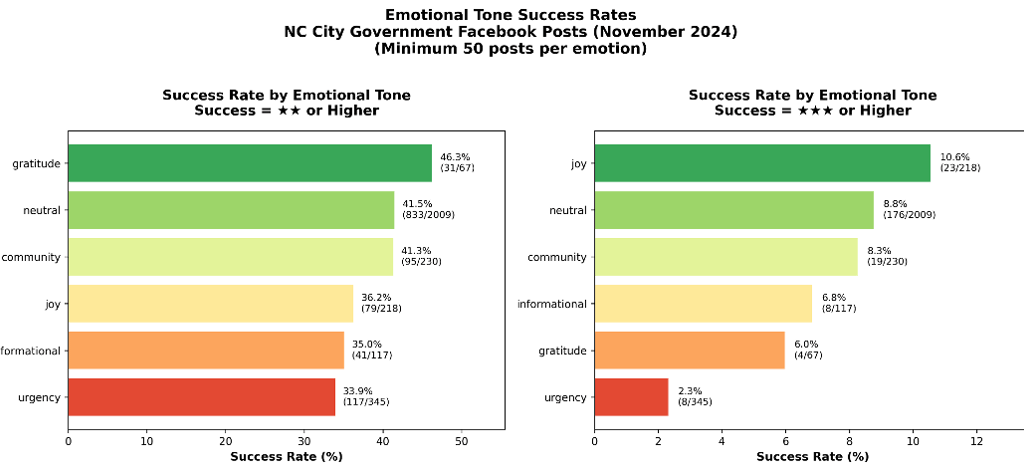
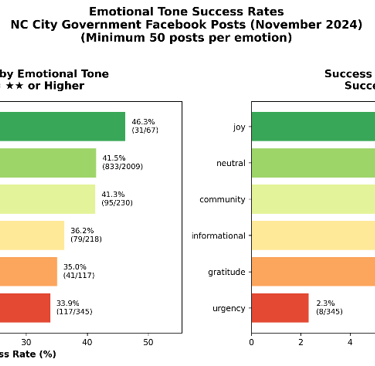
Analyses of local government posts reveal a striking pattern: joyful or positively framed messages are disproportionately represented among highly engaged posts, while messages conveying urgency—alerts, warnings, or time-sensitive notices—rarely achieve similar interaction levels.
At first glance, this may appear to suggest that urgent communication is ineffective. The research suggests otherwise.
Urgency, Visibility, and Silent Attention
Urgent posts often function as information delivery mechanisms, not invitations to interact. Residents may read these messages carefully without liking, commenting, or sharing them. In such cases, low engagement reflects successful transmission rather than disengagement.
This distinction is critical for public institutions. Engagement metrics capture visible reactions, but they do not measure comprehension, awareness, or compliance. A road closure notice that generates few likes but prevents confusion or congestion may be far more successful than a celebratory post that attracts hundreds of reactions.
When messages are clear, unambiguous, and action-oriented, audiences have little incentive to respond publicly. Interaction increases when messages are affective, identity-relevant, or socially expressive—conditions that apply more readily to positive or community-oriented content.
As we have argued earlier in this series, effectiveness depends on aligning communicative structure with purpose. Emotional tone should be evaluated through the same lens.
Why Positive Emotion Drives Engagement
Positive emotional tone—especially joy—appears to play a distinct role in local government communication. Joyful posts often highlight shared experiences: community events, local achievements, or moments of collective pride. These messages invite residents to signal affiliation and belonging through low-cost actions such as liking or sharing.
Research on affective intelligence suggests that positive emotion reinforces approach-oriented behavior, encouraging individuals to engage rather than withdraw. At the local level, where institutions are experienced as proximate and personal, this effect may be particularly strong.
Importantly, positive emotion does not merely increase interaction; it may also contribute to longer-term relational outcomes. Studies of community resilience and participatory storytelling suggest that positive messaging can foster a sense of belonging and institutional warmth, creating a reservoir of goodwill that supports trust during more challenging moments.
Neutral and Community-Oriented Messages
While joyful posts dominate the highest engagement tiers, neutral and community-oriented messages often exhibit stable, reliable engagement across time. These posts may not generate spikes in interaction, but they contribute to a consistent communicative presence.
From an infrastructural perspective, this reliability matters. Social media communication that oscillates dramatically between high-affect content and urgent alerts risks appearing erratic or opportunistic. Neutral messaging provides continuity, reinforcing expectations about tone and purpose.
This finding aligns with broader research emphasizing that consistency is a form of credibility in public communication.
Interpreting Engagement Without Overvaluing It
One of the central risks in applying research findings about emotional tone is metric overreach. High engagement can be seductive, particularly when dashboards and platform analytics foreground visible interaction. Yet engagement is not synonymous with effectiveness.
As we noted earlier in the series when discussing the limits of research-based prescriptions, empirical patterns must be interpreted in context. Emotional tone influences engagement, but engagement itself is only one indicator among many—and often not the most important one for public institutions.
This is especially true when engagement incentives conflict with institutional norms. Governments are not entertainers, nor should they optimize communication solely for effective response.
Learning from Patterns Across Jurisdictions
Comparative analysis can help practitioners contextualize their own engagement patterns. Observing how different jurisdictions deploy emotional tone across similar situations can illuminate when low engagement reflects informational success rather than failure.
Tools such as GovFeeds support this kind of reflective analysis by allowing practitioners to examine engagement outcomes across communities without reducing performance to rankings or simplistic benchmarks. Used thoughtfully, such tools complement the research literature by grounding abstract findings in real-world practice. When leadership questions why an urgent post received low engagement, practitioners can use peer-based evidence to demonstrate that this pattern is normal—and that success should be measured by mission, not metrics alone.
Emotion as a Strategic, Not Tactical, Choice
The research on emotional tone suggests a broader lesson: emotion should be treated as a strategic design choice, not a tactical afterthought. Positive emotion can build connection and visibility; urgency can convey critical information efficiently; neutrality can provide stability and predictability.
Effective government communication does not maximize any single emotional register. Instead, it aligns tone with purpose, audience expectations, and institutional responsibility—recognizing that silence, clarity, and restraint can be just as meaningful as enthusiasm. When practitioners can explain these distinctions with evidence, they are better positioned to defend their tone choices when facing scrutiny from leadership or councils.